
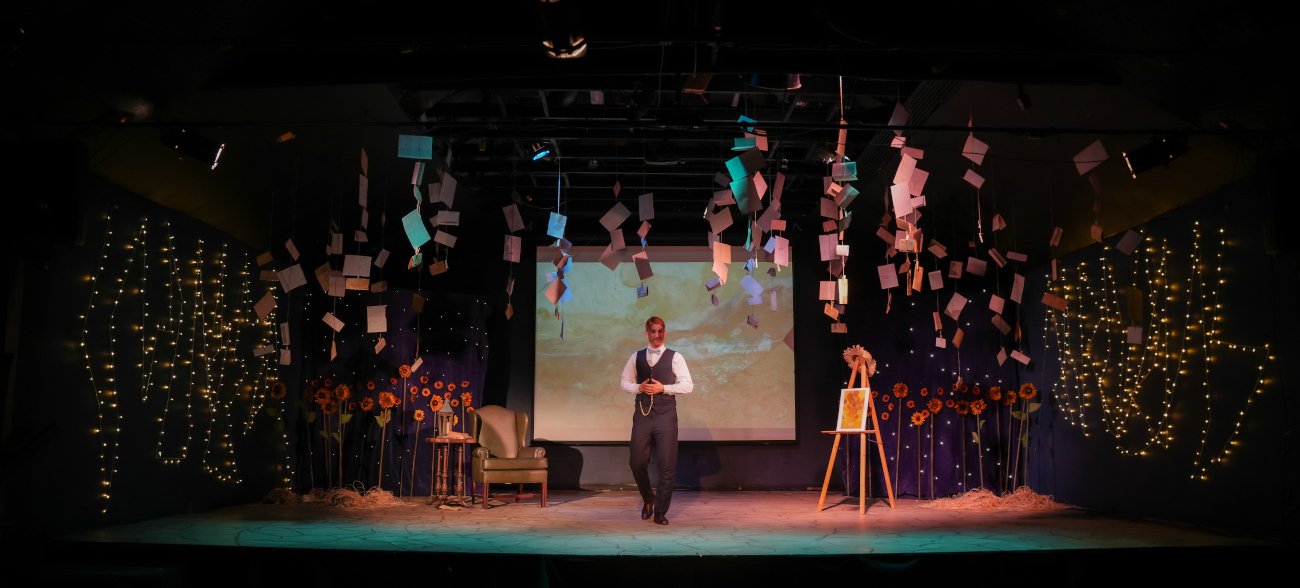
Leonard Nimoy’s one-man biographical play Vincent arrives at London’s Camden People’s Theatre from 14 to 23 January (press night Friday, 15 January at 6:45pm), starring Spanish-American actor, voiceover artist, and motion capture performer Richard Canal Tinius.
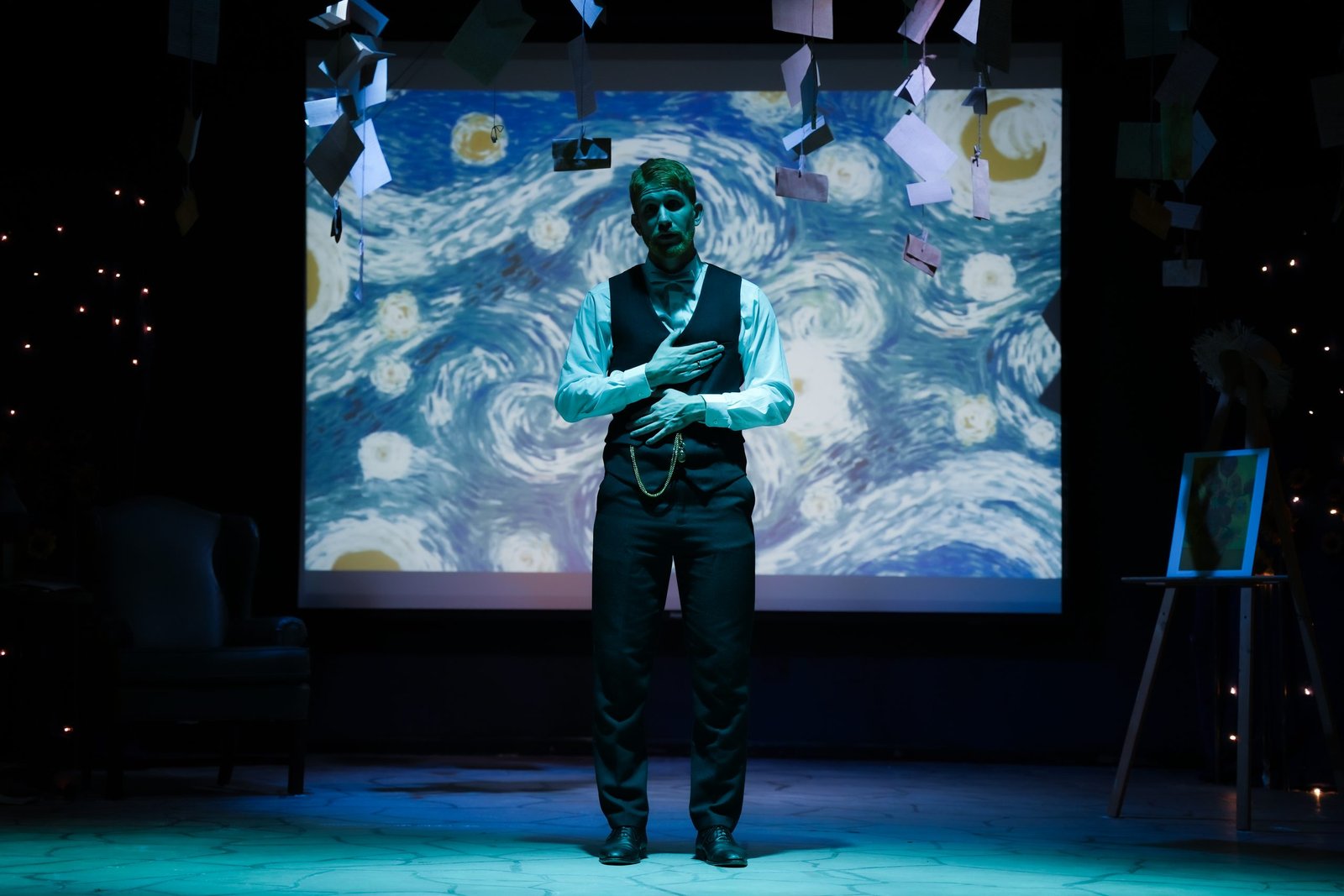
Inspired by more than 500 letters exchanged between Vincent van Gogh and his younger brother Theo, the play unfolds one week after Vincent’s death. Set against 250 projections of van Gogh’s paintings, Theo revisits their years-long correspondence to celebrate his brother’s life and work—looking past the myth of the tortured, solitary genius to uncover the real man behind the legend.
First written and performed by Nimoy in 1978 (adapted from Phillip Stephens’ stage play Van Gogh and filmed as a 1981 TV movie), this revival donates its profits to mental health charity Mind UK. It also marks the debut production from Tinius’s upcoming theatre company, which focuses on solo shows about historical figures alongside R&D residencies at Projet la Rue in Normandy, France.
The Artiscape sat down with Richard Canal Tinius to discuss embodying Theo’s perspective, bringing van Gogh’s letters to life on stage, and reframing mental illness and creativity.
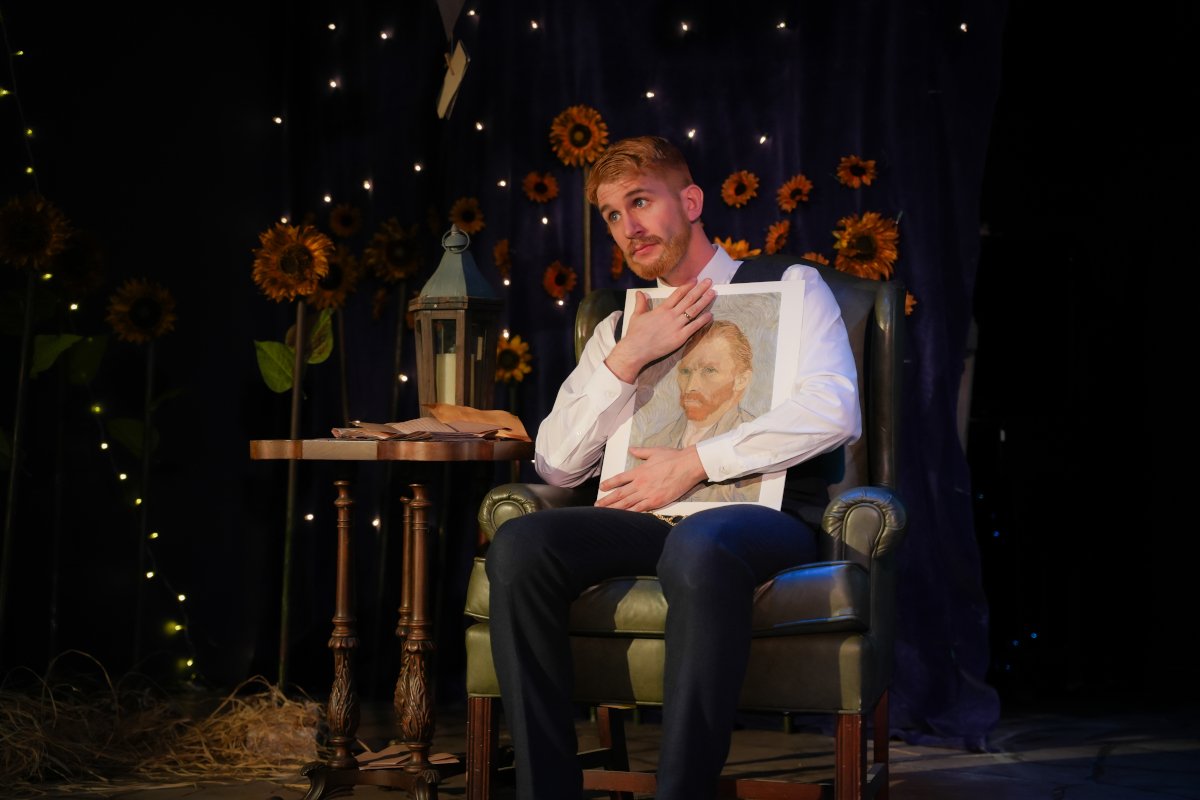
Embodying Theo’s Perspective: Since the play is written from the perspective of Theo van Gogh processing his brother’s death, how do you handle the emotional weight of holding the stage alone while channeling both Theo’s personal grief and his love for Vincent?
A eulogy is, indeed, a celebration of life, without a fixation on death. Theo’s intention as a brother, and therefore my mission as an actor, is to make the audience feel the joy of Vincent’s presence. They need to fall in love with the man Theo loved before they can fully appreciate the magnitude of his loss. The heartbreak of his absence is a result of the contrast between Vincent’s vivacity, vibrancy, and volatility and the depression, despondence, and despair that drove him to suicide. So despite the subtext of grief that underlines the whole play, it is highlighted by happiness, even humor.
My father passed away on July 29th, 2026, the very same date Vincent died in 1890. His celebration of life made me reflect deeply on what Vincent is, and on the ways we remember, love, and carry people we love and lose. It has also given me an invaluable source of fuel as an actor: in a very immediate sense, I’ve internalized the physical sensation of processing grief, of struggling to find the words, of feeling them pour out when they finally come. It’ll be important to express that grief, night after night, without leading to burnout!
Bringing the Letters to Life: Van Gogh’s letters are deeply intimate written prose. What techniques do you use as an actor to translate written, historical correspondence into a dynamic, lived performance on stage?
Vincent elevates Theo’s testimony from being an obituary—you can learn that in a documentary! All 600+ letters can easily be bought and read. To justify them being staged, they need to be relived, not recited, so history feels present and not like a rehearsed account of the past.
Vincent’s letters reveal an extraordinarily rapid, restless, relentless mind. Albert Aurier, an art critic and admirer of van Gogh’s forward-thinking work, described it as “a brain in eruption, irresistibly pouring its lava into all the ravines of art.” He was famously (at the time, notoriously) a force of nature with moods that fluctuated like a mistral’s fierce winds, and his letters are no different: thoughts spill into one another; emotions shift spontaneously within each letter; ideas leap from one subject to another with an almost breathless urgency.
We worked to capture that energy by treating each letter as a living train of thought—a bullet train “charged with electricity,” as the artist Paul Gauguin described him. To create a sense of immediacy, our approach includes dispensing with punctuation, merging Vincent’s musings with movement, and balancing these with sudden stillness to highlight moments of serenity without breaking momentum.
Navigating a One-Man Show: Carrying a solo show requires immense stamina and focus. How do you prepare physically and mentally to keep the audience engaged through such an intense, multi-layered narrative?
My preparation draws heavily on the ALBA technique to separate the physical expression of emotion from the psychological experience of it. I create a visceral, psychosomatic response that communicates emotional truth to an audience without repeatedly relying on personal emotional recall and exhausting myself. My neurodivergence also informs how I compartmentalise and process complex emotional material. Plus, living with bipolar II has given me a lifetime of experience navigating intense, sometimes sudden emotional fluctuations.
Having performed long-form solo work before—Cry, Blueberry at the Camden, Brighton, and Gothenburg Fringe festivals—I have experience sustaining an audience through material tackling difficult social issues.
Stepping into Nimoy’s Script: As an actor interpreting a script originally performed by Leonard Nimoy, how do you make the role your own while respecting the foundations Nimoy laid down?
I’m the same age as Theo was when Vincent died, which offers a particular immediacy compared to an actor revisiting that age from the latter half of life. Plus, it can be hard for audiences to separate a well-known actor from his past roles—in Leonard Nimoy’s case, his Star Trek fame. Being a new face does help me start with a clean slate! This, with the flexibility inherent in having a script that was penned not by the playwright but by the subject of the play, allows for a lot of room.
Furthermore, I portray Vincent as a separate character rather than merely shades of Vincent through Theo’s eyes, as originally prescribed—so I must also reckon with precedents set by past interpretations of van Gogh. Fortunately, the letters are a treasure trove, since there are no audiovisual references other than the Vincents conceived by Kirk Douglas, Tim Roth, Willem Dafoe, and others. This offers a unique opportunity to recreate such a famous historical figure from scratch, building a wholly personal interpretation from the words, thoughts, and emotions he left behind. I can honor the foundations and still have autonomy over the work—to illuminate a different facet of van Gogh, namely Vincent the lover instead of Vincent the martyr, madman, or monk.
Connecting Mental Health to Performance: With profits going to Mind UK, does performing a story that deals so directly with mental illness and grief change your emotional approach to the text on a night-to-night basis?
No, not fundamentally.
In fact, I am particularly wary of allowing the association with mental health to sensationalise Vincent’s struggles or reduce him to his illness. Vincent does not show a man who made art defined by mental illness; it shows a man who made art despite mental illness. That distinction is essential. Vincent van Gogh was so much more than his darkest moments, and I want audiences to leave recognising the fullness of his humanity rather than simply remembering his suffering.
Supporting Mind UK reinforces the importance of that perspective: I believe mental health advocacy should strive not merely to raise awareness of illness, but to champion the possibility of living a rich, meaningful, and creative life alongside it.
Performance Impact: What is the primary emotion or insight about Vincent and Theo’s relationship that you hope your performance leaves with the audience when the lights go down?
The van Gogh brothers’ relationship reveals that Vincent’s identity, artistry, and legacy cannot be separated from Theo. Irrespective of Theo’s self-effacing humility, the paintings are Vincent’s and Theo’s.
Audiences are inspired by Vincent’s extraordinary paintings and poignant words, and intrigued by the life that preceded his artistry and the everyman Theo reveals. But what brings them to tears is the brotherhood Theo recounts. They identify themselves with his frustration of loving someone who’s yet to find their path, his burnout of caretaking someone who is ill, his grief of losing someone to death too soon… and the admiration, the commitment, the belief that motivated him to give lifelong financial, emotional, temporal, and spiritual support to someone he loved so much.
As poet John Donne meditated, “No man is an island.” Underdogs are not lone wolves. The myth of the solitary artist is dispelled by the fact that their success is always thanks in part to the solidarity of friends, mentors, teachers, patrons, lovers, partners, parents, families, and (in van Gogh’s case) siblings. So this production of Vincent is dedicated to these people who make art a possibility, and beauty a reality.
Production & Listings Details
Written by Leonard Nimoy, directed by Cody Stuckenschneider, and designed by Richard Canal Tinius, Vincent runs for 90 minutes with no interval and is suitable for ages 12+.
Performances take place 14 – 16 and 21 – 23 January (Thursday – Saturday) at 6:45pm at Camden People’s Theatre, 58–60 Hampstead Rd, London NW1 2PY. Tickets are priced at £20, £15 (concessions), and £12 (students) and can be booked at cpttheatre.co.uk or by calling 020 7419 4841. You can follow Richard Canal Tinius at richardcanaltinius.com, on Instagram at @richardcanaltinius (#VincentCPT), and on Facebook.